
Most work-management tools make one decision for you before you type a word: they decide what your work is. A task tracker gives you tasks. A CRM gives you contacts and deals. Those categories are fixed at the factory, and your job is to pour real work into them.
Timill starts from the other end. It has a single building block — a configurable record called an Item — and you decide what it means. This chapter is about one idea with outsized consequences: why a single flexible record beats a pile of fixed ones.
What goes wrong with fixed categories
Pre-set categories feel fine until your work stops fitting them. A clinic’s “appointment” is nothing like a software team’s “sprint”. A law firm’s “matter” is nothing like a builder’s “work package”. When the tool’s idea of your work doesn’t match the real thing, people improvise: they overload fields, keep a spreadsheet on the side, invent conventions only their own team understands. Piece by piece the information splits between the official system and the workarounds — and the single source of truth quietly stops being true.
One record, defined by you
Two words make the whole idea click:
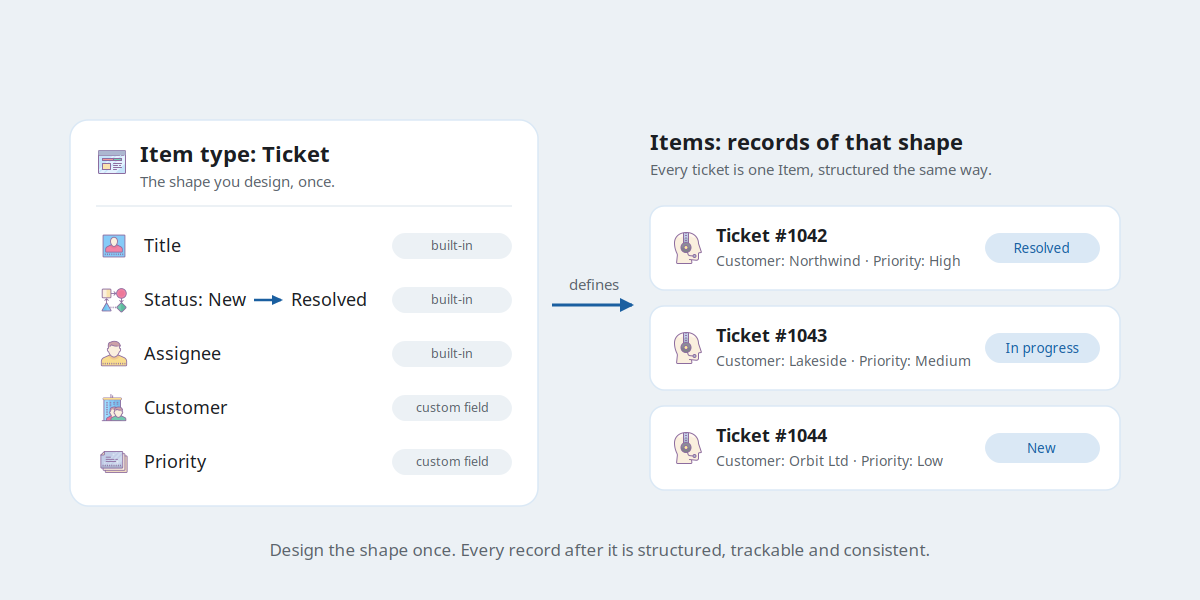
- An item type is the shape you design — its fields, its statuses, its layout and its rules.
- An Item is a single record of that shape.
Design the type “Ticket” once, and every ticket after it is an Item that follows that shape. Every Item arrives with the familiar basics built in — a title, a status, an assignee, a due date — plus history, attachments and comments. Everything beyond that is yours to define through custom fields, with more than fifteen kinds to choose from.
The thinking is simple: the closer the tool’s model sits to how your team actually works, the less your team has to work around it. So instead of asking the business to think like the software, you shape the software to think like the business.
What you get out of it
Modelling your real objects — an actual Patient, Work Order or Case — pays off in places you don’t expect:
- Structured from day one. You can filter, report on and automate your data instead of reading one document at a time.
- The side spreadsheets fade. The system finally fits the work it was built to hold, so the private workarounds lose their reason to exist.
- One foundation underneath. Anything you add later — a dashboard, a cross-team link, an automation — works on every kind of record, with no special cases.
What it looks like in practice
A support team designs a Ticket: the customer it belongs to, a priority, and a workflow that runs from New through to Resolved. None of it is generic — it’s their process, written down once. From then on, every issue is simply a new Ticket , structured and trackable, and the same approach extends to whatever the organisation needs to manage next.
Get the Item right and a great deal follows. It’s the piece that lets Timill wrap around the way you already work, instead of handing you one more mould to squeeze into.
Curious how this would look for your team? Book a 30-minute conversation — at your pace, no commitment.