
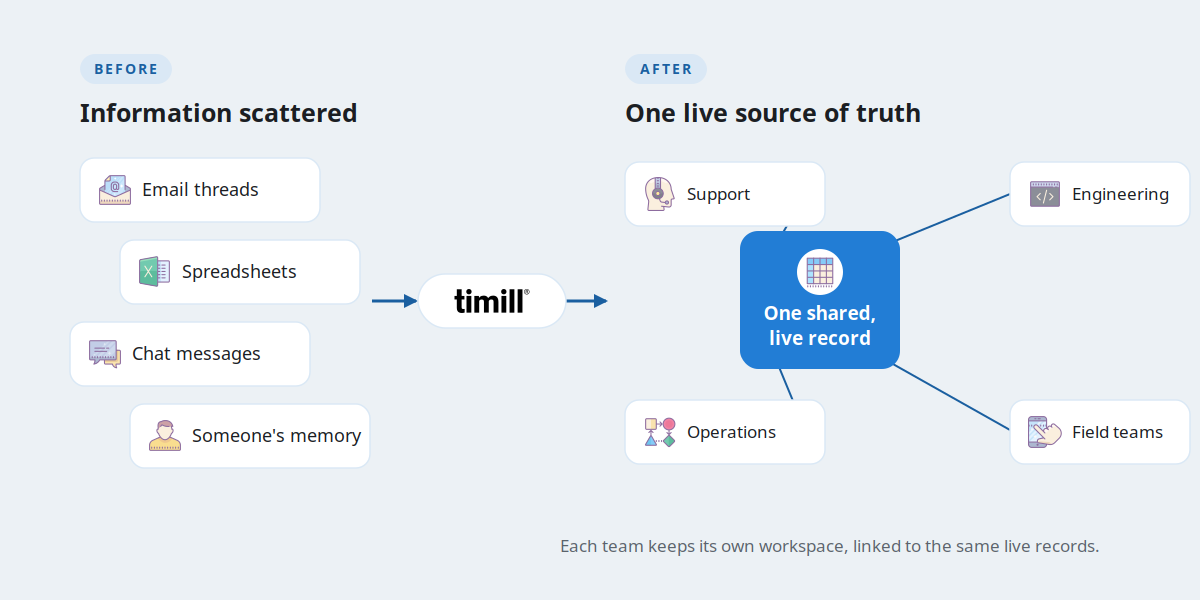
Ask a simple question in most organisations - what’s the current state of this piece of work? You rarely get a single, confident answer. The truth is spread across an email thread, a spreadsheet someone updated last week, a chat message, and a colleague’s memory. Everyone is busy, and no one is quite sure they’re looking at the latest version. That small uncertainty, repeated hundreds of times a day across a company, is the quiet tax Timill is built to remove.
The problem: information drifts apart
As an organisation grows, the truth about its work scatters. The same customer, order, or case ends up recorded in three different tools, each slightly out of step. Teams build their own spreadsheets to cope, and those spreadsheets quietly become the real system — accurate, indispensable, and invisible to everyone outside the team. The cost is rarely dramatic. It is a steady drip: duplicated effort, dropped hand-offs, and decisions made on information that was already out of date.
A different starting point
Most work-management tools arrive with an opinion about how you ought to work, baked in as fixed categories like “tasks” or “tickets”. If your work happens to fit, good. If it doesn’t, you spend your time bending your reality to fit the software. We think that’s backwards.
Timill is a work-management platform, built in Vaasa, Finland, that you shape around the way your organisation already works. Instead of fixed categories, you define your own: the kinds of records you keep, the steps they move through, the dashboards you watch, who can see what, and what should happen automatically. In short, you build your own work-management system — without writing software to do it.
Just as important is what Timill is not. It isn’t a heavy system that demands you rip out and replace what you already have. It’s a flexible layer around how your organisation works, sitting alongside the tools you already rely on. The promise behind it is deliberately plain: your organisation, up to date — one shared, live source of truth, so people stop chasing versions across inboxes and spreadsheets.
What changes day to day
Timill is broad on purpose, but the everyday value comes down to a handful of things:
- Model your real work. Describe the things you actually manage — a Patient, a Case, a Work Order, a Delivery — and Timill holds them as structured records you can sort, filter and report on, not as loose documents.
- Connect the teams that depend on each other. Each team gets its own workspace, and their work links across departments — so a support issue can flow into the right development task without anyone re-typing it or losing the context.
- See progress live. Boards, lists, calendars, timelines and charts read straight from your current data, so the status everyone needs is already there — no one has to stop working to assemble a report.
- Show the right people the right things. Access can be set by role and right down to individual fields, so each person sees what is relevant to them and nothing they shouldn’t.
- Get information in without re-keying. Collect it through forms, import it from Excel or CSV, or let Timill’s AI read a document and turn it into structured records for you.
- Let the routine run itself. Reminders, hand-offs and recurring checks can happen automatically, so work keeps moving without depending on someone remembering.
Setting all of this up is helped along by AI as well: describe what you need in plain language and Timill can draft the record types, dashboards and analysis for you to start from. It runs on the web and on native iOS and Android apps that stay in sync in real time, and you can use it as a hosted service or run it on your own infrastructure.
Built for the way different industries work
Because nothing in the model is tied to one kind of business, Timill is used across very different fields — engineering, healthcare, legal, construction, logistics, manufacturing, professional services, real estate, retail, education, government and the non-profit sector among them. The common thread isn’t the industry; it’s the need to keep work structured, connected and visible.
What it looks like in practice
The same platform looks completely different from one organisation to the next, because each one models its own work. Three short examples:
A software company connects support and engineering. A support agent logs a recurring complaint, and the ticket links straight to a bug in the engineering team’s workspace. Engineers can see exactly which customers are affected and why it matters; support watches the fix progress on the same record without chasing anyone for an update. Both teams read one live picture — and the customer hears back sooner. No status meeting required.
A clinic keeps patient care joined up. Reception books an appointment against a patient record; the doctor opens it and finds the history, allergies and treatment plan in one place; anything needing a follow-up surfaces on its own list instead of living in someone’s memory. Medical details stay hidden from the front desk, so each role sees only what it should — and nothing falls through the gaps between shifts.
A construction firm runs site and office off one plan. A project breaks down into work packages on a shared timeline, each with its contractor and budget, and requests for information are tracked from open to answered. Because the site and the office read the same records, a delay shows up the moment it happens — not at next week’s meeting, when it is already a problem.
Getting started is a conversation, not a sign-up
Timill isn’t a tool you sign up for and figure out alone. It’s set up as a guided partnership: we explore how you work, design a configuration that fits, set it up with you, and support it as your needs change. The aim is a system that mirrors your organisation from day one and grows with it — not a blank slate you have to assemble under pressure.
If the scattered-information problem sounds familiar, that is exactly the gap Timill is built to close.
Curious how this would look for your team? Book a 30-minute conversation — at your pace, no commitment.