
“Where do things stand?” is one of the most expensive questions an organisation asks. Not because the answer is hard to know — it’s sitting in the work already — but because someone has to stop working to assemble it, format it, and send it round. By the time anyone reads it, it has quietly gone out of date. This chapter is about getting that answer for nothing, and giving everyone the same one.
The reporting tax
In most organisations, finding out the state of the work means pulling someone off the work to describe it. The information is real enough. But gathering and formatting it costs hours, usually from the people you can least afford to interrupt — and the weekly status meeting exists mostly to collect what has already slipped a few days behind. It’s a tax on attention, paid over and over, for a snapshot that’s stale on arrival.
The status is simply there
Timill removes the assembling step. The current state of the work lives on a page you open — and because it’s drawn straight from the live records your team is already updating, it’s true the moment you look. Nobody compiles it. Nobody refreshes it. The report stops being something a person makes on a Friday and becomes something that’s just there, current, whenever anyone needs it.
A view for every role
Visibility isn’t one thing, and not everyone wants to see the same thing. The person doing the work needs a short list they can act on today. The person accountable for it needs the trend. A client needs a clean, safe summary. So in Timill you don’t hand everyone one crowded dashboard — you build a page for each role, and each person opens the one that shows what they need and nothing they don’t.
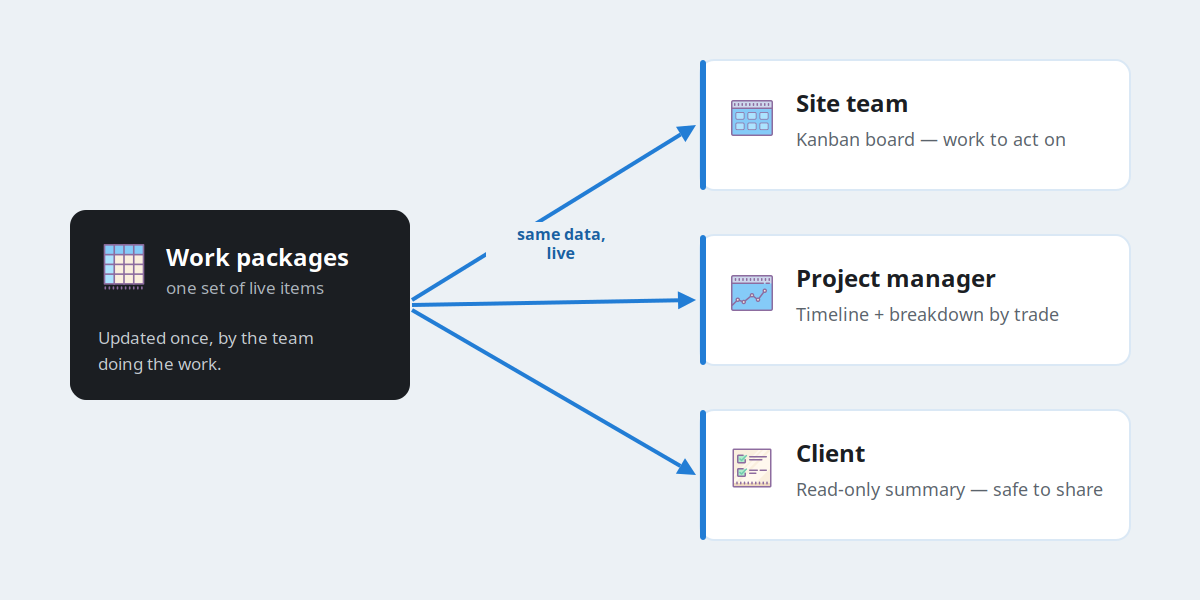
What keeps it honest is that every one of those pages reads from the same live records. The views differ; the data underneath is identical. There’s never an argument about whose numbers are right, because there’s only one set of numbers — each person is simply looking at the slice that matters to them. And because access reaches right down to individual fields, a role only sees what it’s cleared to see: the same project can show full costs to the manager and a progress-only view to the client, from one source.
Decisions on what’s true now
When the picture is always current, decisions get made on reality instead of last week’s snapshot. Problems show up while there’s still time to do something about them. The status meeting shrinks from a ritual for finding out what happened into a short conversation about what to do next — and the hours that used to go into reporting go back into the work.
In practice: a dashboard per role
The same records, a different dashboard for each role — everyone sees what they need, and only that. Three very different teams:
On a construction project
- Site foreman — a board of this week’s work packages, ready to act on.
- Project manager — a timeline and a cost breakdown by trade.
- Client — a read-only progress summary, with sensitive figures hidden.
Three people, one set of work packages. Nobody waits for a Friday report, and nobody sees a number that isn’t theirs to see.
In a clinic
- Nurse — the patients on this shift and the tasks due for each.
- Ward manager — bed occupancy, admissions, and staffing load at a glance.
- Compliance lead — overdue checks and open incidents, with clinical detail kept out of view.
The patient records are shared; the dashboards are not. Each role opens straight into the slice of the work that’s theirs.
On a sales team
- Account executive — their own pipeline and the next action on every deal.
- Sales manager — the team forecast and where deals are stalling.
- Finance — a clean revenue summary, free of deal-by-deal noise.
One pipeline underneath, three jobs to do — so each person gets the view that fits the job, not a report built for someone else.
Giving each role its own live view of one shared source is how Timill keeps an organisation up to date — and turns status from something you chase into something everyone simply has.
Curious how this would look for your team? Book a 30-minute conversation — at your pace, no commitment.